Welcome to Adaptive Neurodiversity. This website hosts a free but unfinished book dedicated to exploring the rich tapestry of human brain diversity and its evolutionary significance.
At the heart of this book is the belief that neurodiversity, the vast array of mental and neurological variation among people, is not just a modern phenomenon but played a crucial role in the survival and thriving of our ancestors in the prehistoric past. For example, we all have a sense that anxiety may have helped hunter-gathers take necessary precautions, that depression may have kept them from taking unnecessary risks, and that today an attention deficit might represent a hunter in a farmers world.
But this book goes further looking at disorders such as schizophrenia, intellectual disability, autism, Alzheimer’s, and the neurological consequences of stress hormones on all our brains. In doing so, the book traverses the fascinating landscapes of evolutionary psychology, anthropology, and brain science to understand how diverse mental traits could have been vital strengths in a world vastly different from our own.
Let’s uncover stories woven into the very fabric of our brains through stories of survival, innovation, and the diverse strengths that have propelled humanity forward through the ages.
This book copyrighted 2024
.
Read the book by navigating the pages in the bar above or clicking on this link for the PDF.
.
Jared Edward Reser Ph.D.
.
.
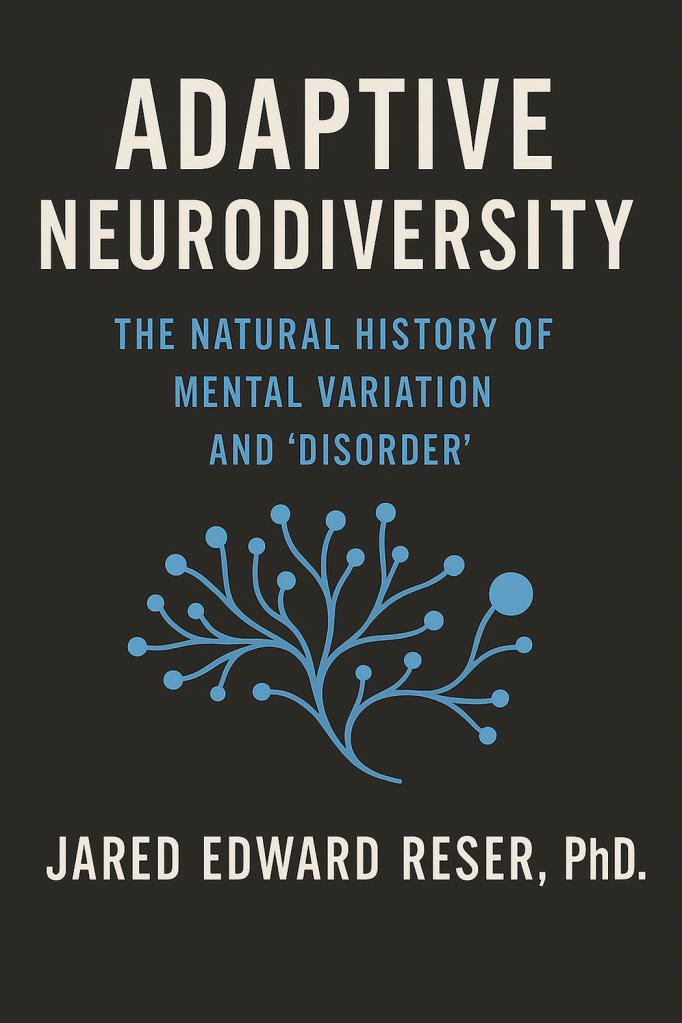
Table of Contents:
Preface………………………………………………………………………………………………………..
Evolutionary Medicine and Mental Disorder.………………………………….
The Value of Intelligence in Nature…………………………………………………
Evolutionary History of Life on Earth………………………………………………
The Stress Cascade……………… ……………………………………….………………..
How Chronic Stress Effected My Brain……………………………………………
Schizophrenia………………………………………………………………………………….
The Metabolic Syndrome………………………………………………………………..
Intellectual Disability……………………………………………………………………….
Down Syndrome……………………………………………………………………………..
Ancient Ancestors………………………………..…………………………………………
Autism …………….……………………………………………………………………………..
Tourette’s……………………………………………………………………………………….
Arthritis………………………………………………………………………………………….
Alzheimer’s ………………….……………………………………………………………….
Conclusions…………………………….……..………………………………………………
.
.
Preface
About This Book
I started developing this book as an undergrad in 2003. I have been working weekly on the present text for more than 20 years. I believe the book has benefitted from that duration as it has given me time to read relevant work, ponder related scientific phenomena and search for supporting evidence.
This book discusses how stress is a signal to animals to use the cognitive razor. Stress is debilitating to the mammal brain. I discuss how to relieve chronic stress in my other book, “Program Peace: Self-care Exercises to Reprogram you Mind and Body.” I wrote these books to complement each other without excessive redundancy, and I would like you to think of them as part of a trilogy. I wrote them so that reading both allows the reader to see a bigger picture.
This Books Faults
I must be clear that much of what is written in this book is speculative. I have strong convictions about it coming from scientific knowledge and personal experience. However, as with much else in evolutionary biology, there is no authority to confirm these hypotheses. To help readers discern between speculation and fact, I have used over 1,000 bibliographical citations to try to make it clear which statements are supported by scientific evidence. Thus, the reader should find that they are learning a lot of reliable information about the natural world even if my theories are wrong. You be the judge of the hypotheses put forth here. And please keep in mind that in many ways, your opinion is just as valid as a neuroscientist’s or evolutionary biologist’s.
Some of the information in this book involves simplification and generalization. To reduce complexity, I’ve simplified many concepts, which may be oversimplified for certain use cases. For example, some tables in the book contain numbers which may be misleading out of context, because I did not spell out all the scientific caveats. Thus, please be careful reproducing the numbers and text here or using them in technical calculations. For this reason, I would like to encourage you to follow up on the points that you’re interested in, and if you create related work in this field, please make sure to do your own research and fact checking.
All the articles I have written that form a basis for these chapters have been cited in peer-reviewed academic literature. Some of the articles these chapters are based on have been cited dozens of times. That some of this material has been published before has given me the opportunity to respond to feedback and criticism. I believe this book is an excellent source of reliable knowledge. However, I know that some of my colleagues would disagree. Some researchers are much more much more fastidious than I am and would have written more from the viewpoints of those with ideological differences. This book favors interpretations that I believe are credible, rather than offering the entire spectrum of opinions. However, I think that this intentional simplification is valuable and allows for important new abstractions. But keep in mind there are expert researchers who would argue with me regarding many points.
For example, monkeys use depression to keep other monkeys from attacking them. To me, this is quite obvious, and I expect that humans become depressed for the same reason. But in articles I have published that have gone to peer review, referees have argued against this vociferously. One expert in the field was convinced that human depression is a way to recruit help from others and nothing else. Instead of giving both views a full treatment in this book, I focus on the explanation I think is most valuable. Usually that explanation is the one that is better applicable to a wider number of other species. So again, this is not a textbook or an unbiased review of the literature.
I’m sure that depressive symptoms have won humans sympathy and handouts and that this plays a role in how depression presents genetically today. But my focus in this book is on the big picture and similarities with other animals rather than complicated theories that sound intuitive to social psychologists. To its detriment, in this book I will not even mention some of the alternate and possibly equally valid theories that sometimes conflict with my own. The main reason being that this book would be too long if I did.
A Note About Mental Disorder, Stigma, and Discrimination
This book talks about individuals with mental disorders and diseases without using politically correct language. I do not go to lengths to avoid offense. In many cases, the writing here addresses marginalized groups as organisms, and this could be offensive or even construed as dehumanizing to some people. This was certainly not my intention. Please keep in the back of your mind that we are all primates, and we are all animals. Any discussion of mental illness is fraught with sensitive issues. I tried to be fair and respectful while still writing succinctly and sticking to the science.
Some readers may feel that I emphasize the disadvantages associated with neurodiversity or make people with certain disorders sound incapable. Of course, my intention is the very opposite. I am sure there are many passages in this book that will be seen as highly insensitive in the near future. This is because what is acceptable in public discourse changes rapidly. I am looking forward to getting feedback from people who can help me fix these errors because I will be updating the book to reflect new science as well as changing social initiatives.
The materials, information, and techniques in this book are general in nature, reflect the opinions of Jared Reser, and are not intended to be a substitute for medical advice. The content provided is for informational purposes only and is not intended to diagnose, treat, or prevent any disease. No specific claims are made regarding the treatment of medical diseases or disorders.
Acknowledgments
I would like to express gratitude to the authors whose work has most influenced my own. These include Harry Jerison, Richard Dawkins, Lewis Thomas, Sarah Blaffer Hrdy, Stephen Jay Gould, Randolph Nesse, George C Williams, Ernest Haeckel, Donald Johanson, Robert Sapolsky, Edward O Wilson, Paul McLean, Nikolaas Tinbergen, Robert Trivers, G.C. Williams, and Simon Baron Cohen among many others cited herein.
About the Author
Jared Edward Reser holds a Ph.D. and master’s degree in brain and cognitive science from the University of Southern California. He also has a master’s in psychology from Pepperdine University. He specializes in writing theoretical research articles and emphasizes an interdisciplinary approach to integrative biology, cognitive neuroscience, and artificial intelligence. You can find out more about his research at http://www.jared-research.com.
 Adaptive Neurodiveristy